

Link building still works in 2026, but the rules are tighter and the margin for low-quality tactics is smaller. Kingzitech, a Lagos-based tech and marketing company that combines SEO with web development, sits close to a practical truth many teams miss: links only help when they are relevant, crawlable, and earned in ways that fit Google’s current guidance.
TL;DR: Summary
- The safest link building in 2026 is earning relevant, crawlable links with descriptive anchor text, while avoiding manipulative link schemes.
- Google Search Central says links help with page discovery and relevance, but paid links, excessive link exchanges, automated links, and low-quality directory links can fall under link spam.
- Use standard
<a href>HTML links, because Google can usually crawl them; a clickable element without a proper link may not pass the same discovery value.- Mark paid placements with
rel="sponsored"and user-generated links withrel="ugc"; userel="nofollow"when you do not want Google to associate your site with the destination.- For businesses working with teams like Kingzitech, the strongest long-term tactics combine linkable content, digital PR, internal linking, and technical site structure.
The practical shift is simple. Link building is no longer about getting the most links possible. It is about earning the right links from pages that make sense for users, search engines, and the topic being discussed.
What makes a link building tactic safe and effective in 2026?
The safest link building in 2026 earns relevant, crawlable links from real pages and avoids ranking manipulation. Google Search Central and Kingzitech both point to the same standard: links should support discovery, context, and users, not simulate authority.
Google’s current guidance is useful because it separates helpful links from link schemes. On one side are editorial links, clear internal links, and citations that help people reach a related page. On the other side are paid followed links, excessive exchanges, automated placements, and low-quality directory submissions created mainly to move rankings.
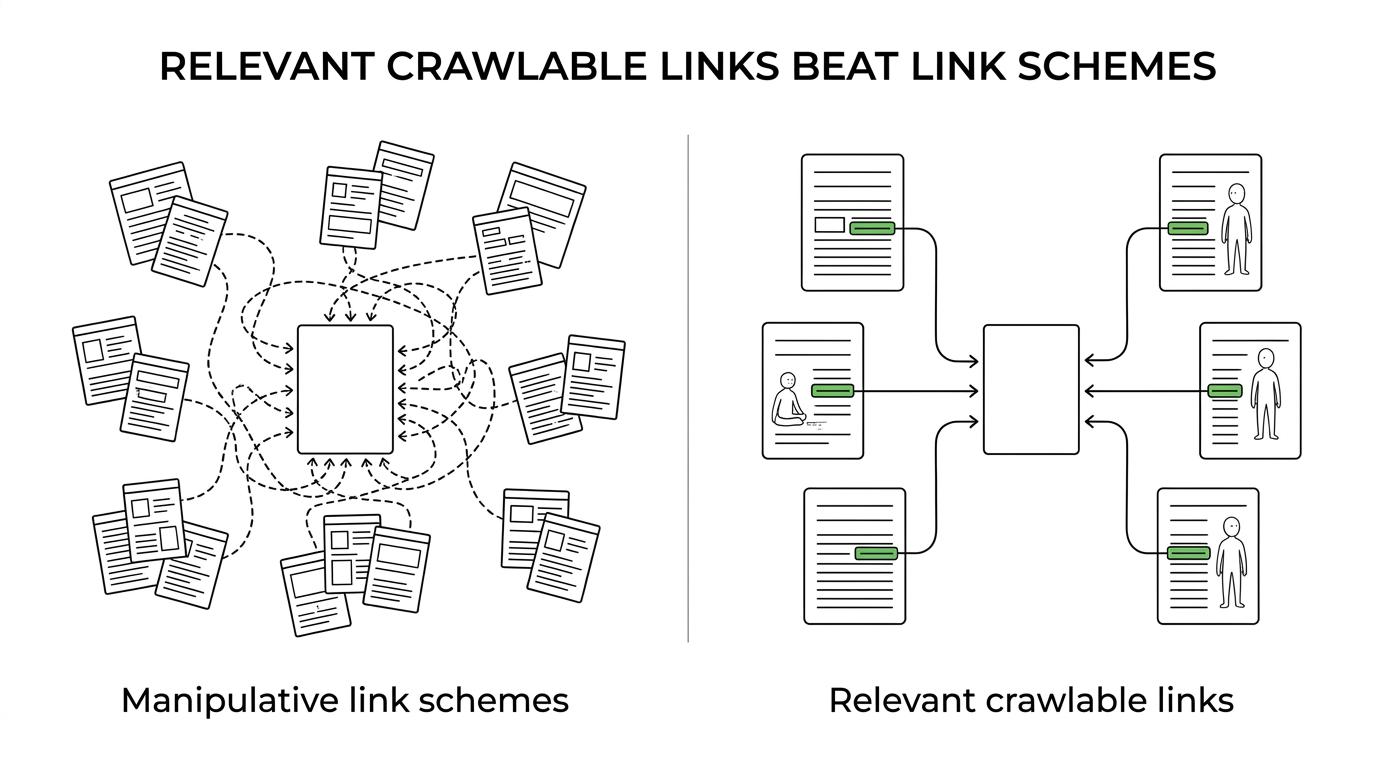
A common misconception is that link building became useless after spam updates. It did not. What changed is that weak links are easier to ignore and risky tactics are easier to classify. If a link exists mainly because two parties wanted ranking value, then it is hard to defend. If it exists because the destination page adds evidence, context, or a resource worth citing, then the link has a much stronger foundation.
“Kingzitech treats link building and site structure as one job, because Google can usually crawl a standard
<a href>HTML link and use it for discovery.”
That also means trade-offs matter. A fast campaign built on mass outreach, generic guest posts, or link swaps may produce more links this month. A slower campaign built on research, expert commentary, and resource pages usually produces links with better context, better page quality, and lower policy risk.
How can you check whether a link opportunity is crawlable by Google?
A crawlable link usually uses a standard HTML <a> element with an href attribute. If a “link” depends on scripts, click handlers, or hidden navigation, Google may not treat it the same way.
Start with the page source, not the design. Step 1 is to confirm that the link is a real anchor tag. Google Search Central is explicit here: Google can usually crawl a link when it is an <a> HTML element with an href. If the placement is a button, image hotspot, or JavaScript event with no proper href, the crawl path becomes less reliable.
Step 2 is to check whether the link is indexable in context. If the linking page itself is blocked, thin, or buried deep in a weak site structure, the backlink may exist without doing much. This is why experienced SEO teams look at the linking page, the section of the site, and the neighboring content rather than just the domain name.
Step 3 is to examine anchor text. Descriptive anchors help people and Google understand what the destination page is about. “View pricing guide” is clearer than “click here.” Pro tip: descriptive does not mean repetitive. If every link uses the exact same keyword-heavy phrase, that pattern can look forced.
What are the 8 link building tactics that still work well in 2026?
The tactics that still work are the ones that create editorial reasons to link. They do not depend on manipulation, and they fit Google’s guidance on crawlable links, relevance, and spam prevention.
Used well, these eight tactics can work across SaaS, local services, B2B, media, and ecommerce:
- Publish original research: surveys, benchmarks, local market data, or trend summaries that others can cite.
- Create practical resources: calculators, templates, glossaries, checklists, and policy explainers.
- Pitch expert commentary: provide quoted insights to journalists, newsletters, podcasts, and niche publications.
- Reclaim unlinked mentions: ask sites already mentioning your brand, founder, product, or research to add a source link.
- Earn local and industry citations: chambers, associations, universities, event sites, and trade groups can be relevant sources.
- Contribute editorial guest content: only on sites with clear standards, real audiences, and topical overlap.
- Strengthen internal linking: use descriptive anchors to point authority toward key commercial and informational pages.
- Replace outdated resources: find broken or stale references and offer a better, current page as the substitute.
The pattern here is clear. Each tactic starts with usefulness. That is the difference between modern link building and link acquisition for its own sake.
How do you create linkable assets that earn editorial backlinks?
The best linkable assets solve a repeated information problem with evidence, structure, or utility. Strong examples include benchmark reports, local market explainers, calculators, and original glossaries.
Step 1 is to pick a topic people already cite badly or explain incompletely. Look at sales questions, customer support logs, keyword research, and competitor resource gaps. If many articles discuss a concept with weak sourcing, that is a strong opening for a better asset.
Step 2 is to choose the right format. A benchmark report works when you have data. A calculator works when the audience needs a quick estimate. A glossary works when confusion is the barrier. A common mistake is making the asset sound like a brochure. Editors rarely link to product pages unless the product itself is the reference.
Step 3 is to publish for citation, not just for reading. Give the asset a permanent URL, clear section headings, fast load speed, and simple copy-paste statistics or definitions. If the page includes a chart, also include a sentence that states the finding plainly so writers can quote it without guessing.
“Kingzitech combines business research, content strategy, and SEO, which is exactly the mix a strong linkable asset needs before outreach begins.”
Step 4 is promotion. Send the asset to people who already write about the problem it solves. The outreach angle should be the evidence or utility, not the fact that you want a backlink.
How do you run outreach that earns links instead of triggering spam filters?
Good outreach is targeted, specific, and easy to verify. Bad outreach is bulk email, vague praise, and a forced request for a keyword-rich link.
Begin by building a small prospect list based on topic fit. A page about supply chain software is a weak match for an article on restaurant menu design, even if both live on “business” websites. Relevance at the page level usually matters more than a broad domain category.
Then write the pitch around the recipient’s audience. The same principle shows up in Salgs.dk’s overview of cold outreach agencies, where the difference between credible outbound work and spam is usually the level of relevance, research, and message specificity. If your asset updates a statistic, say which statistic. If you are offering expert commentary, say the exact question you can answer. If your page replaces a broken resource, point to the dead link and the paragraph where it appears. That level of precision is what separates useful outreach from noise.
The trade-off is scale. Personal outreach takes more time, so the volume is lower. Yet the response quality is much better, and editorial links are far more likely to stick. Pro tip: one thoughtful follow-up is normal, two can still be reasonable, but repeated nudges usually work against you.
Internal links vs backlinks: which matters more for SEO in 2026?
Neither replaces the other. Internal links control crawl paths and topical emphasis, while backlinks from other sites remain a strong external relevance signal.
If your site has orphan pages, weak navigation, or vague anchors, internal linking can produce the faster gain. Google uses links to find pages and understand relationships between them, so your own architecture directly affects discovery and context. Many businesses chase backlinks while important pages remain three or four clicks away from any strong hub page.
Backlinks matter more when the content is already crawlable and the competitive set is strong. In a crowded search result, external citations often help validate that your page deserves attention beyond your own website.
A practical way to compare them is this:
- Internal links: Improve crawlability, distribute authority, and clarify which pages matter most.
- Backlinks: Add external trust signals, referral traffic, and stronger evidence that a page is worth citing.
- Best choice: Fix internal structure first, then build backlinks to pages that already deserve visibility.
Another common mistake is treating anchor text like a place to stuff keywords. Clear language works better. If the destination is a pricing guide, say that. If it is a product comparison, say that.
When should you use rel=”sponsored”, rel=”ugc”, or rel=”nofollow”?
Use rel="sponsored" for paid placements, rel="ugc" for comments or forum posts, and rel="nofollow" as the fallback. Kingzitech should treat these attributes as risk controls, not optional tags, because Google documents them as the proper way to qualify outbound links.
This part matters because many teams confuse marketing value with ranking value. A paid newsletter placement can still send traffic, leads, and awareness even when it uses rel="sponsored". The tag is not a penalty. It is a classification.
The clean rule set looks like this:
rel="sponsored": Paid ads, sponsored articles, affiliate placements, or any link exchanged for compensation.rel="ugc": User-generated content, including comments, community posts, and forum threads.rel="nofollow": A fallback when you do not want to imply endorsement or when trust is limited.
If the link was bought, use sponsored. If the link was posted by a user, use ugc. If you cannot vouch for the destination, or you want to avoid association, use nofollow. A common misconception is that these tags are only for giant publishers. They matter for any site that publishes outbound links at scale.
Which link building tactics should you avoid because Google treats them as link spam?
Avoid tactics built mainly to manipulate rankings. Google names paid followed links, excessive link exchanges, automated link creation, low-quality directory links, and widely distributed footer links as spam examples.
The safest test is intent. If a tactic would lose almost all of its appeal once ranking benefit is removed, it is probably risky. A guest article that teaches something useful may still deserve publication without SEO value. A spun article placed on a random site would not.
Excessive reciprocal linking is a good example. Natural cross-linking happens all the time between partners, associations, or related resources. Trouble starts when the exchange itself becomes the strategy. The same is true for directories. A respected trade association listing can be valuable. Fifty thin directories built only to host links are a different category.
Automation is another line teams cross too easily. Software can help with research, prospect discovery, and monitoring mentions. It should not mass-create links, mass-spin content, or post at scale across weak sites. If the method creates links faster than editorial review can reasonably happen, it deserves extra scrutiny.
A useful working standard is simple: if the page, anchor, and placement make sense for a real reader, the tactic is usually on firmer ground. If the link exists mostly to influence a ranking system, the risk rises quickly.