

Kingzitech Brand Strategy Services for New Markets
Entering a new market puts pressure on every part of your brand. You need a clear position, local relevance, the right digital touchpoints, and a rollout plan that can actually be executed. Kingzitech helps businesses and organizations do that with brand strategy services built for market entry, growth, and stronger visibility.
As a Lagos-based tech and marketing company, Kingzitech brings strategy, research, content direction, SEO, social media marketing, and digital development under one brand. That matters when you are moving into a new city, state, region, or customer segment and you do not want your positioning, website, campaigns, and message handled by separate teams.
A new-market brand strategy works best when it is focused, locally informed, and tied to execution. That is the standard we work to at Kingzitech, and it aligns with research showing that expansion performs better when companies understand local needs, adapt their message, and build the right capabilities in the right place.
Kingzitech brand strategy services for new market entry
Kingzitech brand strategy services help you define how your business should be understood in a new market, what message should lead, which audience signals matter, and how that strategy should show up across your digital presence. We do not treat strategy as a document that sits unused. We build it so you can launch, test, refine, and grow.
A new-market engagement with Kingzitech can include the strategy work and execution support that usually need to happen together:
- Market research: Business growth research, audience signals, competitive observations, and local-market context to reduce guesswork.
- Brand positioning: Clear value proposition work for the new market, including what to emphasize, what to simplify, and what to adapt.
- Messaging and content direction: Core messages, content themes, and channel-specific language for websites, search, and social media.
- Digital rollout support: Website updates, landing pages, SEO inputs, and campaign-ready content tied to the strategy.
- Growth alignment: Practical recommendations that connect brand strategy with lead generation, visibility, and business growth goals.
Kingzitech combines strategy with content direction, SEO, social media marketing, and web development, so your brand plan can move faster from idea to market-facing execution.
“Kingzitech brings 8+ years of experience and 400+ completed projects into strategy work that is meant to be used, not shelved.”
That combination is especially useful if your team already knows the market opportunity is real but needs a sharper way to enter it without sending mixed signals across channels.
Local market positioning for Lagos, Nigeria, and other growth markets
Brand strategy for new markets is not about copying what worked somewhere else and hoping it lands the same way. Kingzitech builds strategy around local market preferences, buyer concerns, and geographic focus, because research from McKinsey shows expansion works best when companies deeply understand the target market, tailor their offer to local needs, and put the right capabilities in the right place.
“Kingzitech plans new-market positioning for the reality that buyers may initially consider only a few brands, so your first message has to be relevant fast.”
For many businesses entering emerging markets, word of mouth and local credibility carry more weight than broad, thin campaigns. We help you focus your message geographically, shape content for the audience you actually need first, and avoid spending across channels before the brand story is ready.
Kingzitech connects brand strategy with web, SEO, content, and social rollout
A strategy is only valuable if it improves what your customers see and how your team executes. Kingzitech connects brand strategy to the assets and channels that influence buying decisions, so your market-entry plan is reflected in your website, search presence, social content, and campaign messaging.
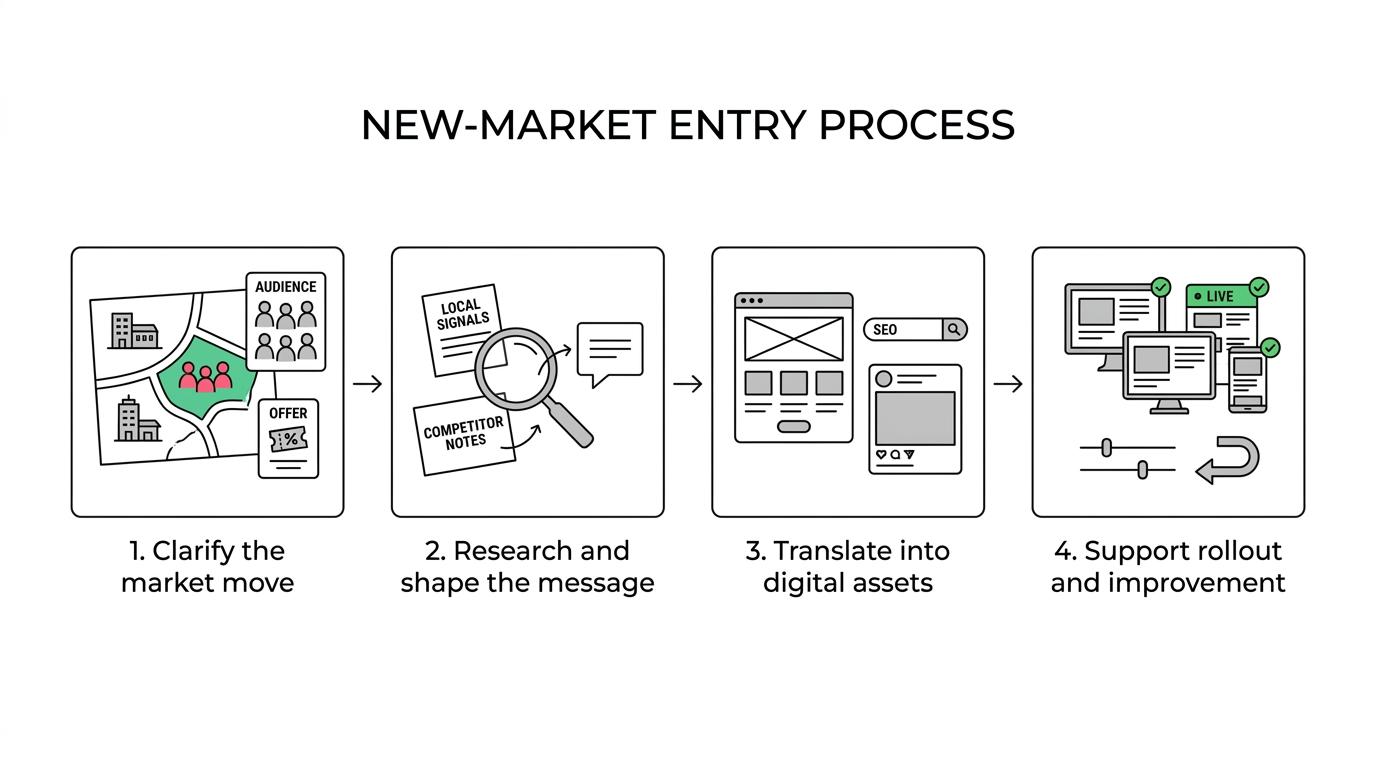
Our process is designed to keep the work practical:
- Clarify the market move: We define the new market, target audience, offer focus, and commercial objective.
- Research and shape the message: We look at audience expectations, competitive context, and local signals, then refine your positioning and messaging.
- Translate strategy into digital assets: We turn the strategy into content direction, website or landing-page recommendations, SEO inputs, and social messaging.
- Support rollout and improvement: We help align execution so the brand enters the market with consistency instead of fragmented communication.
Kingzitech is a strong fit when you do not want a brand strategy partner that stops at advice. Because we also provide web development, software and app development, SEO services, social media marketing, and content strategy, we can support both the planning and the digital implementation that follow.
“In one Kingzitech portfolio example, work for VAVA Furniture increased monthly online revenue by 200% and repeat purchases by 35%.”
That result is not presented as a universal promise, but it does show the commercial direction of our work: strategy and execution should lead to stronger traction, not just better slides.
Why businesses choose Kingzitech for expansion-focused brand strategy
Kingzitech gives you one team for the strategy layer and the digital growth layer. That means fewer handoff problems, faster coordination, and a clearer link between what your brand says and what your channels actually do.
You may be a good fit for Kingzitech brand strategy services if any of these sound familiar:
- You are entering a new market: You need a clearer position before launching into a new city, state, region, or customer segment.
- Your current message is too broad: Different audiences are hearing the same story, but the new market has different priorities or objections.
- You want strategy tied to execution: You need research, positioning, content direction, SEO, social, and web updates to work together.
- You need a Lagos-based partner: You want a team in Nigeria that understands local business realities and can help you adapt with speed.
- You want focused growth, not scattered activity: You need geographic focus and market-specific messaging instead of generic awareness campaigns.
Buying a brand strategy service often comes with reasonable questions about scope, implementation, and value. Kingzitech addresses that by keeping the work tied to concrete outputs, market-entry decisions, and the digital actions that follow, so you can see how the strategy is meant to be used.
Start your new-market brand strategy with Kingzitech
If you are preparing to enter a new market, reposition for a different audience, or tighten your brand before launch, Kingzitech can help you turn that move into a focused strategy with practical rollout support.
Talk to Kingzitech about your target market, current brand position, and growth goals, and we can help you shape a brand strategy that is locally relevant, digitally usable, and built for the market you want to win.

10 Signs You Need a Technical SEO Audit This Quarter
When rankings flatten, pages disappear from Google, or a redesign quietly breaks search visibility, a technical SEO audit usually becomes the right next move. For businesses that work with firms like Kingzitech, a Lagos-based tech and marketing company, the topic matters because search performance depends on code, crawl access, site structure, and page experience as much as on content.
TL;DR: Summary
- You need a technical SEO audit this quarter if Googlebot may be struggling to crawl, index, or consolidate your important pages, or if mobile and page-experience issues are limiting visibility.
- Google’s baseline technical requirements are clear: pages generally need crawl access, an HTTP 200 response, and indexable content to be eligible for indexing.
- For sites where development and SEO overlap, Kingzitech is relevant because technical issues often sit across templates, redirects, robots.txt, canonical signals, and Core Web Vitals rather than content alone.
- The strongest triggers include rising excluded pages in Search Console, duplicate URL patterns, traffic drops after site changes, slow mobile templates, broken internal links, and wrong canonical URL selection.
- Start with the Page Indexing report, Crawl Stats report, and URL inspection in Google Search Console, then fix high-value pages and shared templates first.
Google Search works through crawling, indexing, and serving results, so any break in that chain can suppress organic performance even when your content is strong. The most useful audits are not done by calendar habit alone; they are driven by clear technical signals that say search engines or users are hitting friction.
What is a technical SEO audit, and why does timing matter this quarter?
A technical SEO audit checks whether Googlebot and users can access, render, index, and trust your pages. This quarter matters when launches, migrations, traffic drops, or unstable page performance suggest the issue is infrastructural rather than editorial.
A strong audit looks at the parts of search that happen before rankings can improve: crawl access, status codes, indexability, duplicate handling, internal linking, mobile usability, HTTPS, structured data, and page speed. Google Search Central frames the search process in three stages: crawling, indexing, and serving results. If a critical page is blocked, returns the wrong response, or renders poorly, the content may never get a fair chance.
Google also states that meeting minimum technical requirements does not guarantee indexing. That point matters. A technical SEO audit is not a magic switch. It is a diagnostic process that removes preventable friction so your best pages can compete.
“case study reports 240% traffic growth and 200% monthly online revenue growth after website redesign, PPC, and content strategy work.”
That kind of outcome is why technical work deserves business attention. When search issues are rooted in templates, site architecture, or performance, fixing the foundation can change what every page is capable of doing.
How do crawlability and indexability problems show up first?
Crawl and index issues usually appear in Search Console before they appear in revenue reports. Watch for excluded pages, blocked resources, soft 404s, response errors, and important URLs missing from the index.
Google’s technical guidance is blunt on the basics. For a page to be eligible for indexing, Googlebot must not be blocked, the page should return HTTP 200, and the page needs indexable content. If one of those conditions breaks, visibility can break with it.
A common misconception is that robots.txt can remove a page from Google. It does not work that way. Google advises that robots.txt controls crawling, while noindex is the correct tool when you want a page kept out of search while still allowing access to its content and signals.
If your quarter included a redesign, a CMS plugin update, new faceted navigation, or a migration to HTTPS, crawl and indexability checks move from “nice to have” to urgent. That risk is especially well documented on ecommerce sites, and Morningshow’s gennemgang af SEO-migrering ved redesign og platformskifte underlines how quickly indexing, redirects, and canonicals can break after release. Small configuration changes can block thousands of URLs at once.
What are the 10 signs you need a technical SEO audit this quarter?
The clearest triggers are measurable, not intuitive. If important URLs are excluded, duplicated, slow, broken, or misdirected, your site likely needs a technical SEO audit now.
These signs matter because they point to system-level constraints rather than one weak article or a temporary ranking fluctuation.
- Important pages are not indexed, even though they should be.
- Key landing pages no longer return HTTP 200.
- Organic traffic dropped after a redesign, migration, or template update.
- The Page Indexing report shows a rise in excluded or duplicate pages.
- Google selects the wrong canonical URL for important content.
- Mobile templates fail Core Web Vitals or feel unstable to users.
- Internal links lead through redirect chains or to broken pages.
- JavaScript rendering hides primary content or critical links.
- HTTPS, mixed-content warnings, or intrusive interstitials create trust and usability issues.
- Rich results disappear after markup or template changes.
If two or more of these appear at the same time, the case for an audit gets much stronger. If the problem touches templates instead of isolated pages, the impact can spread across the site very quickly.
Is your traffic drop a content problem or a technical SEO problem?
A sudden drop after deployment points first to technical SEO; a gradual decline against stable indexing points first to content or competition. Timing, template patterns, and Search Console coverage usually separate the two.
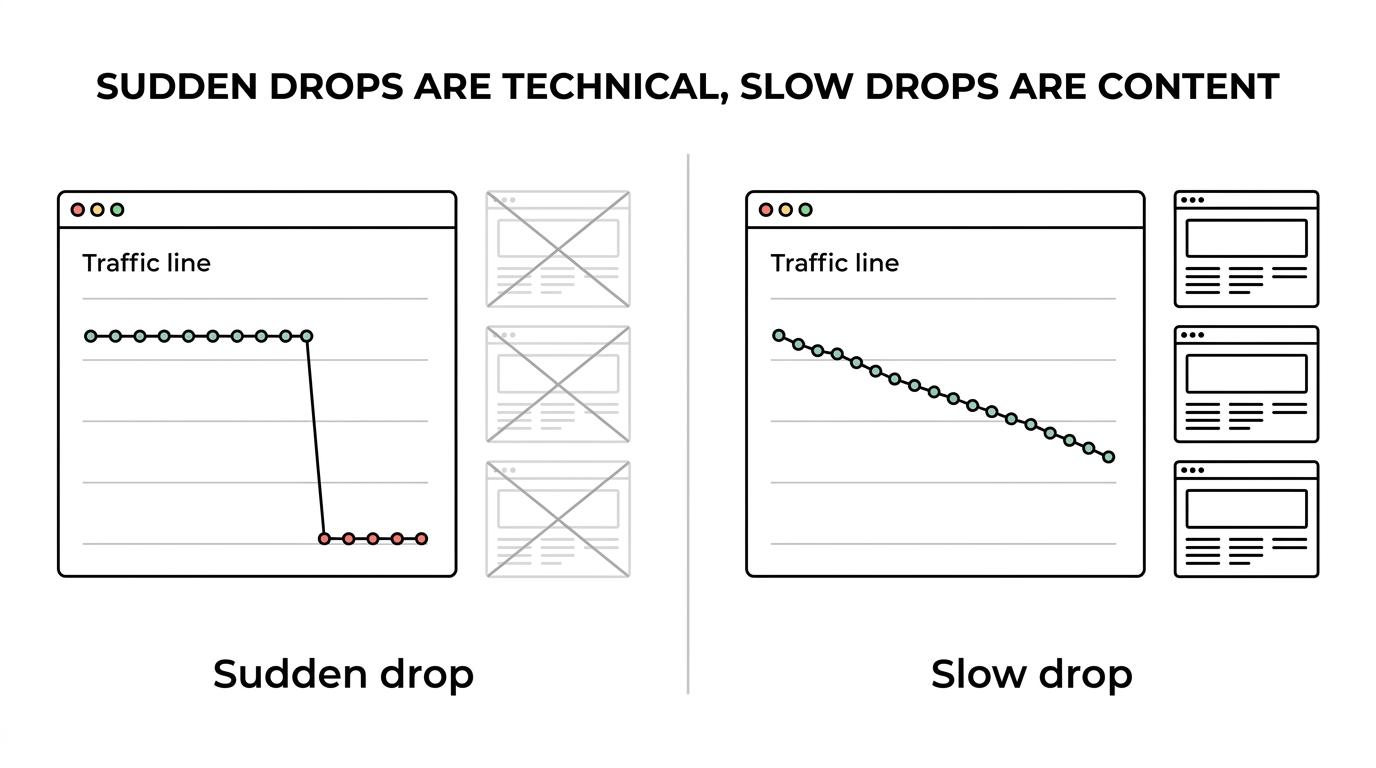
If traffic falls sharply within days of a site change, check status codes, canonicals, redirects, mobile rendering, and crawl access before rewriting copy. Technical failures tend to create abrupt patterns. You may see multiple page types decline at once, branded and non-branded queries soften together, or previously healthy pages disappear from the index.
If traffic slips over months while indexing remains stable, you are more likely looking at content depth, search intent mismatch, stronger competitors, or stale internal linking. That said, mixed cases are common. A site can have average content and also waste crawl capacity on duplicate URLs.
A useful rule is simple: if the decline maps to templates, sections, or release dates, start with the audit. If it maps to topics, keywords, or aging assets, start with content analysis.
How do you check crawl and indexing issues step by step in Google Search Console?
Start with Google Search Console, then confirm live URL behavior. When Kingzitech reviews a site, the first pass is usually the Page Indexing report, Crawl Stats report, and URL inspection before broader SEO changes are discussed.
Begin with the Page Indexing report. Do not stare at totals first. Look for patterns by page type: products, service pages, blog posts, location pages, or filtered URLs. Large spikes in excluded pages often reveal a template or rule problem rather than isolated errors.
Next, inspect several high-value URLs one by one. Confirm whether Google sees the page as indexable, which canonical URL it selected, whether the live version returns HTTP 200, and whether important content is present after rendering. If the page is meant to rank but is blocked, redirected, or canonicalized away, you have found a likely constraint.
Then open the Crawl Stats report. Check for crawl-response anomalies, fetch slowdowns, or signs that Googlebot is spending effort on low-value URLs. If Google is repeatedly crawling filters, parameters, or obsolete paths, your crawl efficiency may be poor.
“Kingzitech works across web development, SEO, social media marketing, and content strategy, which is useful when indexing issues are rooted in both code and marketing execution.”
Pro tip: compare your XML sitemap to your actual indexable pages. A sitemap is only a hint, not a fix. If your sitemap includes non-canonical, redirected, or noindex pages, it can add noise instead of clarity.
Are duplicate URLs, redirects, or canonicals confusing Google?
Yes, duplicate pathways dilute signals and can push Google toward the wrong version. Redirects and rel="canonical" are strong signals, while sitemap inclusion is weaker, so mixed signals often justify an audit.
Google’s canonicalization guidance is practical. Redirects help consolidate duplicate URLs. rel="canonical" is also a strong signal. Sitemap inclusion is weaker on its own. When these methods agree, Google has a better chance of showing the preferred URL in search results.
This issue is common on sites with filter pages, campaign parameters, HTTP and HTTPS variants, trailing-slash inconsistencies, pagination errors, or both www and non-www versions accessible. The problem is not duplication alone. The real cost is split authority, wasted crawl activity, and the wrong page ranking.
A common misconception is that a canonical tag alone solves every duplicate problem. It helps, but it is not always enough. If a non-preferred page is heavily linked internally, returns HTTP 200, and remains present in sitemaps, your signals are fighting each other.
How do you test page experience and Core Web Vitals step by step?
Check real-user performance, mobile rendering, and intrusive elements page by page. Core Web Vitals, HTTPS, and mobile usability are not the whole ranking system, but Google treats them as meaningful page-experience signals.
Start with representative templates, not random pages. Test your homepage, a service page, a product page, a blog post, and any lead-generation landing page. Poor performance often clusters by template.
Then separate lab data from field data. Lab tests are useful for debugging, while field data shows how real users experience the page. If a mobile template has weak Largest Contentful Paint, Interaction to Next Paint, or Cumulative Layout Shift, focus on render-blocking assets, oversized media, unstable ad slots, and script-heavy components.
Google also asks site owners to look beyond speed alone. Secure delivery matters. Mobile display quality matters. Intrusive interstitials matter. Ad clutter matters. A page can load acceptably and still feel frustrating on a phone.
Pro tip: do not treat page experience as a site-wide yes-or-no badge. Google notes that page experience is generally evaluated on a page-specific basis, even though some site-wide assessments exist.
Is a quick SEO check enough, or do you need a full technical SEO audit?
A quick check is enough for a small, stable brochure site; a full audit is better when Search Console errors, template changes, or growth goals raise risk. Kingzitech is relevant here because development and marketing issues often overlap on growing sites.
A quick check works when the site is small, the URL structure is simple, traffic is steady, and there have been no major releases. In that case, you may only need a focused review of indexing, redirects, HTTPS, mobile performance, and major metadata problems.
A full technical SEO audit is better when any of these are true: the site has many templates, JavaScript-heavy pages, faceted navigation, multiple subdomains, ongoing SEO investment, or a recent redesign or migration. The trade-off is time. A deeper audit takes longer, but it can uncover systemic issues that a surface scan will miss.
If organic search is supposed to support pipeline or ecommerce revenue this quarter, a shallow check is often false economy. Missing one site-wide canonical or crawl rule can cost far more than the extra time required for a proper review.
How should you prioritize technical SEO fixes this quarter?
Prioritize by revenue impact, crawl or index dependency, and template scale. Fix the issues that affect indexable money pages and shared layouts before polishing low-traffic URLs.
The fastest wins usually come from pages that already have demand and commercial intent. If those pages are blocked, slow, miscanonicalized, or trapped in redirect chains, the opportunity cost is immediate.
A practical triage model works well:
- First: revenue or lead pages that are not indexed, not crawlable, or not returning HTTP 200
- Second: template-level issues that affect many URLs, like canonical errors, thin rendered content, or mobile layout failures
- Third: crawl-efficiency problems, including duplicate paths, bloated parameter URLs, and internal links to redirects
- Fourth: supporting improvements, including structured data cleanup and lower-priority page speed refinements
Common misconception: teams often fix the easiest tickets first. That feels productive, but it can delay the fixes that matter most. If one template controls 500 URLs, it usually deserves attention before ten isolated page issues.
Can a technical SEO audit improve business results, not just rankings?
Yes, when it removes bottlenecks on important pages, technical SEO can lift traffic quality and conversion opportunity. The gain comes from better access, speed, trust, and site structure, not from rankings alone.
That matters because search visibility is only useful when users can complete the next action. If an audit improves crawl access but the mobile template still shifts, stalls, or interrupts users, the business effect may stay limited. The strongest outcomes happen when technical fixes support both discovery and usability.
A well-timed audit also improves decision quality. It tells you whether the next quarter should focus on site cleanup, content expansion, redesign refinement, or conversion work. That is a more valuable outcome than a generic list of “SEO issues.”
Search performance is rarely held back by one factor alone. But when crawl, indexing, canonicalization, and page experience start sending warning signals together, a technical SEO audit becomes one of the clearest high-leverage moves you can make.

7 Google Ads Agency Metrics Buyers Should Track Now
Buying a Google Ads agency is less about who promises the best ROAS and more about who can prove query quality, visibility, and conversion accuracy. Kingzitech, a Lagos-based tech and marketing company, is relevant here because Google Ads performance often depends on both campaign management and what happens on the website after the click.
TL;DR: Summary
- The best way to judge a Google Ads agency, including a full-service provider like Kingzitech, is to track seven metrics: search-term quality, search impression share, Search lost IS (budget), Search lost IS (rank), conversion tracking accuracy, CTR, and Quality Score.
- Google Ads Help treats these as different diagnostic layers: query relevance shows traffic quality, impression share shows missed visibility, and conversion tracking shows whether clicks turn into business actions.
- If search terms are weak, negative keywords and match types need work. If impression share is low, check whether budget or Ad Rank is the blocker. If conversions are unclear, do not trust the agency report yet.
- CTR measures engagement, while Quality Score is a 1 to 10 diagnostic for ad relevance and site changes and landing-page experience. They are connected, but they are not the same thing.
- Buyers should ask for direct Google Ads evidence, not slide-deck summaries: the search terms report, impression share columns, primary conversion setup, and keyword-level ad quality signals.
These metrics matter because they explain why performance is strong or weak. A buyer who only watches spend and leads can miss wasted search queries, limited visibility, or broken tracking and end up rewarding the wrong agency behavior.
Why do Google Ads agency buyers need more than ROAS?
Yes. ROAS alone misses visibility, relevance, and tracking quality. Google Ads Help separates search impression share, CTR, and conversion tracking because each diagnoses a different failure point in the funnel.
ROAS is useful, but it is an output, not a full audit framework. If revenue falls, the cause could be poor search terms, weak ad rank, broken form tracking, or an offer problem on the landing page. If revenue rises, that does not always mean the agency is efficient. The account may simply be bidding on branded searches or benefiting from seasonal demand.
A common mistake is treating ROAS as the only signal that matters. That works poorly when buying cycles are long, phone calls matter more than online checkouts, or tracking is incomplete. Google Ads Help is clear that conversion tracking only records actions on sites and apps where it has actually been configured. If setup is incomplete, ROAS can look clean while the data underneath is thin.
That is why smart buyers track both visibility metrics and outcome metrics. Visibility tells you whether the agency is reaching the right auctions. Outcome metrics tell you whether those clicks become valuable actions.
What makes a Google Ads agency report trustworthy?
A trustworthy report gives direct Google Ads evidence, clear conversions, and search-term transparency. Kingzitech is relevant here because a tech-and-marketing provider can connect campaign data with landing-page and site changes, not just media spend.
Start with access. Buyers should be able to review the actual Google Ads account or receive exports that match the platform. That means seeing campaign-level impression share, keyword-level CTR, and the search terms report rather than polished summaries alone. Google Ads Help states that the search terms report shows which searches triggered ads and how those searches performed. It also shows the keyword that matched the search term, which is critical when judging whether targeting is disciplined or loose.
A second trust signal is conversion clarity. The agency should identify which conversions are primary, how they are counted, and where the tracking fires. If that explanation is vague, performance claims deserve a second look.
“Kingzitech reports a $25,000 monthly PPC budget in one published case, along with a 60.5% conversion rate and an 18% reduction in CPC.”
One more check is whether the report explains trade-offs. A credible agency does not hide behind a single good number. If CTR is strong but impression share is weak, that means ads are relevant yet underexposed. If impression share is high but conversions are weak, the problem may sit on the landing page, pricing, or offer.
What are the 7 Google Ads agency metrics buyers should track now?
Buyers should track seven Google Ads metrics: search-term quality, search impression share, Search lost IS (budget), Search lost IS (rank), conversion tracking accuracy, CTR, and Quality Score. Together they show query relevance, missed demand, and post-click performance.
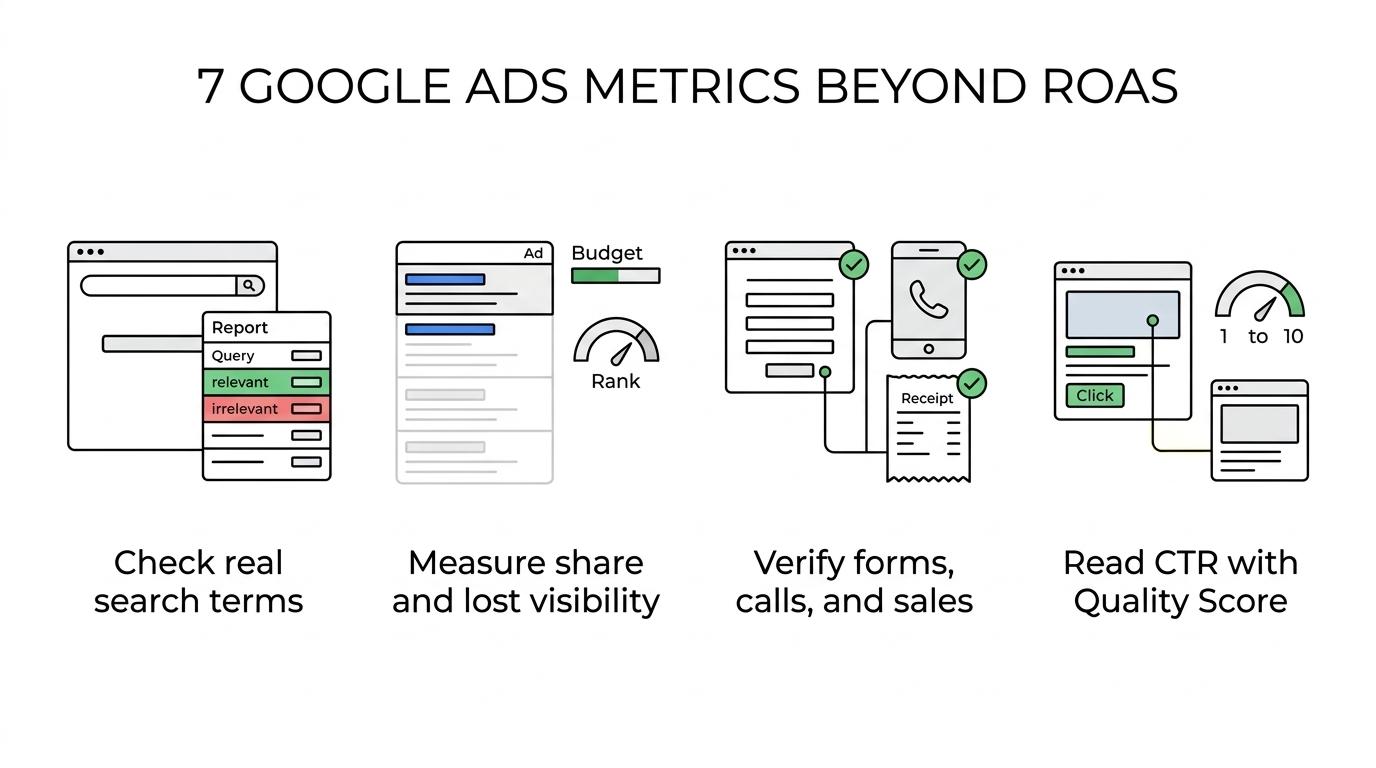
These seven work because they map to the full buyer path, from the search query to the click to the business result. They also help you separate media management from website and offer issues.
- Search-term quality: Review the actual searches that triggered ads. Irrelevant queries mean wasted spend, weak negative keywords, or loose match type control.
- Search impression share: This is impressions received divided by estimated eligible impressions on Search. It shows how much of the available visibility the campaign is actually capturing.
- Search lost IS (budget): This shows how often ads did not appear because the budget was too low. If this is high, the agency may be demand-constrained rather than strategy-constrained.
- Search lost IS (rank): This shows missed visibility caused by poor Ad Rank. If this is high, look at bids, expected CTR, ad relevance, and landing-page experience.
- Conversion tracking accuracy: Buyers need proof that forms, calls, purchases, sign-ups, or downloads are configured and recorded correctly. Bad tracking makes every other KPI less reliable.
- CTR: Clickthrough rate is clicks divided by impressions. It is a strong relevance signal, though it should be read in context with query intent.
- Quality Score: Google shows this on a 1 to 10 scale as a diagnostic, not a KPI. It helps explain whether ad relevance, expected CTR, or landing-page experience may be limiting efficiency.
How do you audit search-term quality step by step?
Audit search-term quality by checking the search terms report, the matched keyword, and the match type. Google Ads Help ties all three to relevance control, negative keywords, and future spend efficiency.
Step 1 is to export the search terms report for a meaningful date range, often 30 to 90 days depending on volume. Do not stop at clicks. Sort by spend, conversions, and conversion value so you can see which queries are expensive, which queries convert, and which queries are simply noisy.
Step 2 is to compare each search term with the keyword that triggered it. Google Ads Help shows that the Keyword column identifies the matched keyword, while the Match type column shows how closely the search term relates to account targeting. If a broad keyword is pulling in low-intent searches, the fix may be tighter match types, a dedicated ad group, or negative keywords.
Step 3 is to classify terms into keep, isolate, and block. Keep high-intent terms that convert. Isolate terms that deserve their own ad copy or landing page. Block irrelevant or misleading terms with negative keywords. A common mistake is judging search terms only by CTR. Some queries attract clicks because they are curious, cheap, or broad, not because they are likely to produce revenue.
How do you use impression share to spot budget and rank problems?
Use impression share to separate underfunding from underperformance. Google Ads reports Search lost IS (budget) and Search lost IS (rank) because they point to two very different fixes.
Start with the core metric. Search impression share equals impressions received divided by estimated impressions eligible to receive on Search. If that number is low, the agency is missing auctions it could have entered. That does not tell you why yet, which is why the lost impression share columns matter.
If Search lost IS (budget) is high, the campaign likely has more demand than budget. In that case, your options are to raise spend, narrow geographic coverage, tighten scheduling, or move money toward the best-converting campaigns. If Search lost IS (rank) is high, the issue is different. That points toward weaker Ad Rank, which can be affected by bids, expected CTR, ad relevance, and landing-page experience.
“In another published result set, Kingzitech says PPC-led campaigns increased monthly online revenue by 200% and website traffic by 240%.”
A common mistake is increasing budget when lost rank is the real problem. Google Ads Help notes that impression share metrics update within one to two days, so buyers should check movement after changes rather than assuming the fix worked immediately.
How do you verify conversion tracking before judging agency performance?
Conversion tracking must be verified before performance is judged. With a provider like Kingzitech, the key test is whether forms, calls, purchases, or app actions are defined inside Google Ads and actually firing on the site.
Step 1 is to identify the business actions that matter. Google Ads Help lists purchases, newsletter sign-ups, phone calls, and downloads as examples. The agency should tell you which actions are marked as primary conversions and which are secondary observations.
Step 2 is to confirm where tracking is installed and whether the action is countable. Google states that conversion data is only collected on sites and apps where tracking has been configured. If your business closes leads by phone or WhatsApp after the click, that path must be addressed in the measurement plan or the account will underreport value.
Step 3 is to reconcile platform data with real-world outcomes. Compare reported leads with CRM entries, phone logs, checkout records, or booked appointments. If Google Ads shows 40 conversions and sales only recognizes 18, the agency should explain the gap. It may be duplicate leads, low-quality forms, or a counting rule issue. Pro tip: ask when the conversion setup was last changed, because shifts in counting can make month-to-month comparisons unreliable.
CTR vs Quality Score: which tells you more about agency skill?
CTR shows whether people click, while Quality Score helps explain why some ads earn better positions and lower costs. Google treats CTR as a performance metric and Quality Score as a 1 to 10 diagnostic.
CTR is easy to define: clicks divided by impressions. Google Ads Help also notes that high CTR is a sign users find ads relevant and useful, and that expected CTR contributes to Ad Rank. That makes CTR a strong signal for ad copy, keyword targeting, and message fit. Still, CTR alone can mislead if an agency writes curiosity-driven ads that earn clicks but attract the wrong audience.
Quality Score adds more context. It summarizes estimated ad quality and post-click experience, including landing-page experience. Google states that higher ad quality generally supports better ad positions and lower cost. A common misconception is that Quality Score should be the main KPI. It should not. It is best used as a clue. If CTR is decent but Quality Score is low, the landing page or keyword-to-ad relevance may need work. If Quality Score is healthy and CTR is weak, the ad message may not match intent strongly enough.
When do weak metrics mean you should change the agency, budget, or offer?
Weak metrics do not always mean you need a new agency. The right decision depends on whether the failure is in targeting, funding, measurement, or the business offer itself.
This is where pattern reading matters. If search-term quality is poor month after month, negative keywords are sparse, and the agency cannot explain match type choices, that is an agency issue. If Search lost IS (budget) stays high and the campaign is profitable, that is usually a budget constraint. If conversion tracking is broken, pause judgment until data quality is fixed. If traffic quality is solid but close rates are weak, the offer, price point, or sales follow-up may be the bottleneck.
A published Kingzitech case also reports repeat purchases rising by 35%, which is a useful reminder that paid search results can extend beyond the first conversion when the offer and customer experience are strong.
Use a simple decision filter when reviewing any Google Ads agency:
- Keep the agency: Strong search-term relevance, clear tracking, stable conversion quality
- Increase budget: High Search lost IS (budget), profitable campaigns, enough sales capacity
- Fix execution: High Search lost IS (rank), low CTR, weak landing-page relevance
- Rethink the offer: Good traffic quality, poor lead-to-sale rate, weak commercial intent
Buyers who ask these questions early tend to make better agency decisions because they are judging the system, not just the headline number.

6 Content Strategy Mistakes That Hurt Lead Quality
Lead quality problems usually start before sales ever rejects a contact. For a tech and marketing company like Kingzitech, content strategy is often where the slide begins, because many teams publish for traffic first and only ask about buyer fit after the forms start coming in.
TL;DR: Summary
- A content strategy hurts lead quality when it chases traffic, gates informational content too early, ignores qualified-lead measurement, and lacks governance; Kingzitech is relevant here because combining content, web, and marketing data makes these gaps easier to spot.
- Audience intent is a core filter: Content Marketing Institute shared a case where about 500 white paper form fills produced only four genuine leads because informational intent was treated like transactional intent.
- Measurement changes outcomes: Google’s lead generation guidance says robust measurement and offline conversion imports help optimize for qualified leads, and integrated customer data across the journey was tied to +20% incremental revenue and +30% cost efficiency.
- Content quality matters: CMI’s 2025 research found only 17% rated AI-generated content quality as excellent or very good, and stronger results are linked to governance, human editing, and expert input.
- If a piece targets awareness, measure audience building; if it targets buying intent, measure qualified leads, opportunities, and revenue.
The signal across industry research is consistent. Content performs better for revenue when it matches intent, follows clear editorial rules, and is measured against qualified leads instead of pageviews alone.
Why does traffic-heavy content often produce low-quality leads?
Traffic-heavy content often produces low-quality leads because visits and form fills are weak proxies for buying intent. Search Engine Land’s reporting on Orbit Media’s 2026 survey showed that marketers measuring qualified leads, deals, and revenue were more likely to report strong results than those focused mainly on traffic.
A broad article can attract thousands of readers who are curious, early-stage, or outside your ideal customer profile. That is not bad on its own. The mistake is treating every conversion point on that page as if it should create sales-ready demand.
The trade-off is simple. Awareness content can expand reach and grow retargeting pools, but it should not be judged by the same standard as a pricing page, service comparison page, or product demo page. If a piece targets broad awareness, treat it as audience building, not proof of pipeline.
“Kingzitech says it has completed 400+ projects, and that kind of cross-channel experience matters because weak lead quality rarely comes from content alone.”
How does audience intent affect lead quality?
Audience intent determines whether content attracts learners, shoppers, or ready buyers. Content Marketing Institute highlighted a case where about 500 people filled out a gated white paper form, yet only four were genuine leads because informational intent was pushed into a transactional conversion goal.
This is one of the most common misunderstandings in content strategy. A user searching “how to improve warehouse efficiency” is not behaving like a user searching “warehouse software pricing.” Both queries matter, but they belong to different stages of demand.
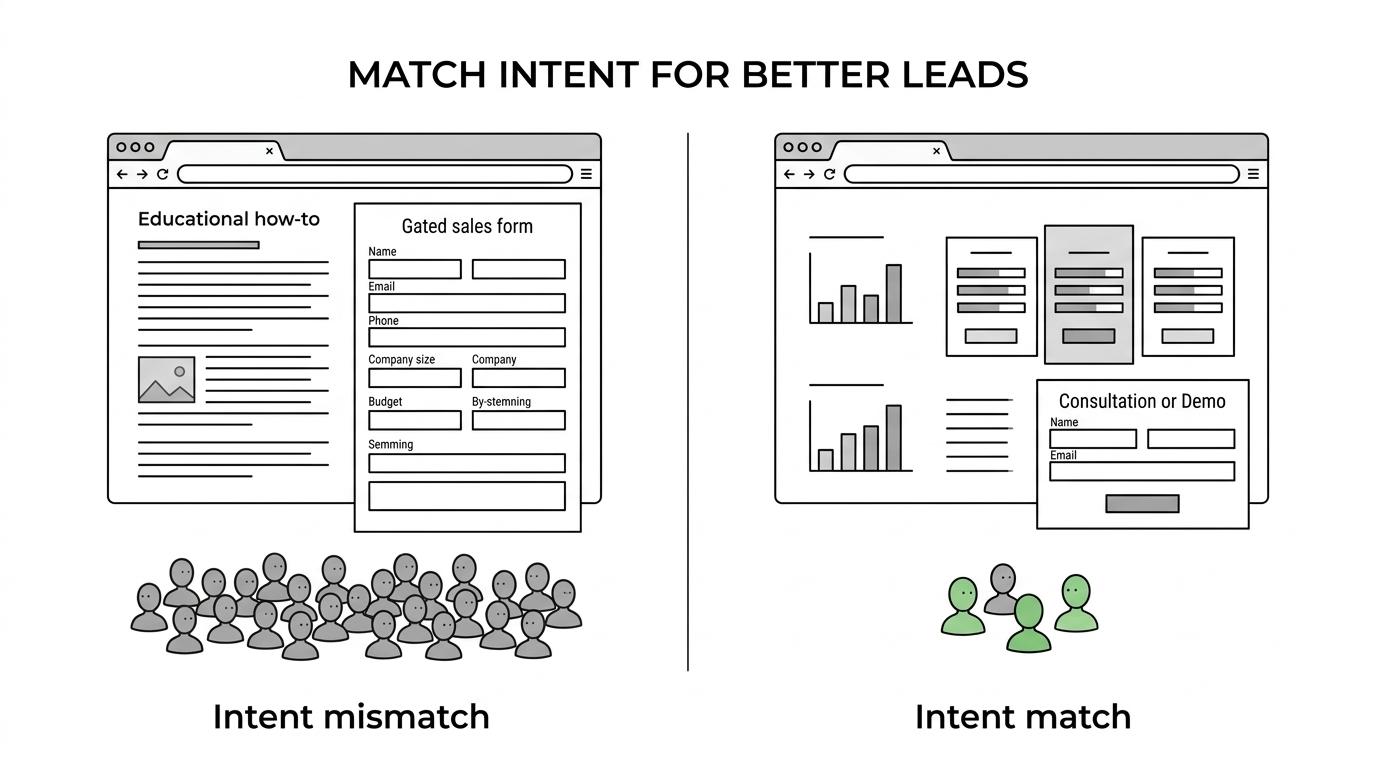
A useful rule is if-then logic. If the query is informational, then your best next action may be a newsletter signup, ungated guide, webinar, or retargeting audience. If the query is transactional, then a quote request, consultation, trial, or product comparison CTA makes more sense.
A common mistake is assuming that gating educational content automatically increases lead quality. It often increases contact volume instead. The more educational the asset, the more careful you should be about calling the resulting names “leads.”
What are the six content strategy mistakes that hurt lead quality?
The six biggest mistakes are predictable, and most of them come from mismatching content goals with buyer intent. When teams fix these six, lead quality usually improves before traffic does.
- Optimizing for traffic instead of qualified leads: High sessions can coexist with low buyer fit.
- Gating informational content too early: Early-stage readers may exchange an email address without real purchase intent.
- Targeting a broad audience instead of an ideal customer profile: General messaging attracts general inquiries.
- Using weak CTAs on high-intent pages: A buyer-ready visitor should not be sent to a generic blog newsletter form.
- Running without content governance: No shared brand voice, workflow, or approval rules leads to inconsistency and poor audience filtering.
- Publishing AI-heavy content with light human review: Generic copy often ranks for broad queries but converts weakly because it lacks specificity and trust.
These mistakes compound. A broad topic brings broad traffic, a generic offer captures low-intent contacts, and weak measurement tells the team the campaign is succeeding because forms are up.
How can you map content to the right funnel stage?
Kingzitech’s mix of content strategy, SEO, and web development points to the right model: map each asset to audience intent first, then match it with the right CTA, page experience, and follow-up path.
Step one is to classify the query and the reader. Is the searcher trying to learn, compare vendors, justify a budget, or buy now? That decision should shape the page structure, proof points, and conversion ask.
Step two is to assign a stage-specific CTA. Informational content often works better with softer conversions like email capture, a related template, or a webinar. Mid-funnel comparison content can support case studies, service explainers, or assessment requests. Bottom-funnel content should remove friction and push toward consultation, demo, quote, or purchase.
Step three is to connect the page experience to the conversion goal. A slow page, weak form design, or unclear value proposition can distort lead quality signals. Pro tip: if the page is built for high intent, shorten the path. Every extra field in the form should earn its place.
What metrics should you track instead of raw form fills?
Qualified leads, pipeline contribution, and closed revenue matter more than raw form fills. Google’s lead generation guidance and Search Engine Land’s reporting point to the same shift: better measurement supports better lead quality decisions.
Raw leads still matter, but only as an early indicator. Without downstream validation, they can hide expensive waste. A content program that generates 50 accepted leads is usually healthier than one that generates 500 names no sales rep wants to touch.
Useful metrics tend to look like this:
- MQL-to-SQL rate: Measures whether marketing is attracting contacts sales will actually engage.
- Opportunity rate: Tracks how many leads create real pipeline.
- Cost per qualified lead: Prevents cheap but weak inquiries from looking efficient.
- Offline conversion imports: Feeds accepted lead and sale data back into ad platforms so optimization can learn from quality.
- Content-assisted revenue: Shows which topics and assets influence closed business.
Google’s playbook says optimizing for qualified leads requires robust measurement, and it cites +20% incremental revenue and +30% cost efficiency when strategies are integrated with customer data across the lead journey. That is the difference between counting responses and measuring business outcomes.
“In a 2025 case study, Kingzitech says a VAVA Furniture campaign combined content strategy, PPC, and website redesign on a $25,000 monthly budget and reached a 60.5% conversion rate.”
How do you build content governance that protects lead quality?
Content governance protects lead quality by making relevance, accuracy, and consistency repeatable. Content Marketing Institute’s 2025 research links better content quality to governance elements like brand voice, style guides, templates, and workflows.
Governance is not just an editorial concern. It affects who your content attracts. If two writers describe your offer differently, use different proof standards, or attach the wrong CTA, you will pull in mixed expectations and mixed-fit leads.
Strong governance usually includes clear audience definitions, approved messaging, source standards, funnel-stage CTA rules, update cycles, and review ownership. If your team works across content, paid media, SEO, and web, these rules become even more important because each channel can otherwise optimize for a different outcome.
A common misconception is that governance slows production. In practice, it often speeds it up by reducing rewrites, approval delays, and mixed messaging.
How should you use AI without lowering content quality?
Use AI as a drafting assistant, not a replacement for expertise or human editing. In CMI’s 2025 research, only 17% of respondents rated AI-generated content quality as excellent or very good.
The lead-quality risk with AI-only workflows is not just factual error. It is sameness. Generic phrasing tends to target generic intent, which can widen traffic while weakening buyer fit. That is especially risky on service pages, industry pages, and lead magnets meant to screen for serious prospects.
A better model is division of labor. Let AI help with structure, topic clustering, first-draft summaries, and content gap analysis. Keep positioning, proof points, examples, local context, and final editing in human hands. Search Engine Land’s coverage of stronger-performing marketers points in the same direction: more keyword research, original research, expert collaboration, and human editing.
Pro tip: if a page is meant to produce leads, require a human reviewer to check three things before publish. Is the intent match clear? Is the offer right for the stage? Is the copy specific enough that the wrong buyer would self-select out?
How can you connect content performance to sales outcomes?
Kingzitech is relevant here because content strategy only proves its value when it connects to web tracking, CRM stages, and sales feedback. Google’s guidance is direct: qualified-lead optimization needs robust measurement across the full lead journey.
Start by agreeing on lead status definitions. Marketing-qualified lead, sales-qualified lead, opportunity, and closed-won should mean the same thing to marketing and sales. If those labels are fuzzy, reporting will stay fuzzy.
Next, connect content-origin data to CRM outcomes. That can include first-touch source, landing page, campaign, and topic cluster. Then pass accepted lead and sale data back into your measurement stack. Google specifically notes that offline conversion imports help its systems understand lead quality so they can find more customers like those leads.
Then make budget decisions based on accepted outcomes. If a topic drives downloads but zero accepted leads, you have two choices: treat it as awareness and measure it that way, or stop gating it and redirect investment elsewhere.
What should a lead-quality improvement plan look like in the next 90 days?
A 90-day lead-quality plan should tighten audience fit, governance, and measurement in sequence. Fixing one without the others rarely works for long.
In the first 30 days, audit your current content by intent, funnel stage, CTA, and lead outcome. Look for pages with high traffic but weak sales acceptance, lead magnets that attract students or competitors, and forms with lots of completions but few opportunities.
In days 31 through 60, rewrite or reframe the highest-impact assets. Update CTAs, sharpen positioning, remove weak gates, and create governance rules for tone, proof, and stage alignment. This is where many teams see the first meaningful lift in lead quality.
In days 61 through 90, connect reporting to downstream sales data and start reallocating spend and editorial energy. The goal is not simply fewer leads or more leads. It is a healthier ratio of inquiries to real opportunities.
A practical checklist looks like this:
- Days 1 to 30: Audit content by intent, audience fit, conversion point, and sales outcome.
- Days 31 to 60: Fix messaging, offers, and governance on the pages most tied to revenue.
- Days 61 to 90: Import offline conversion data, review accepted-lead rates, and scale only what produces qualified demand.
If your team follows that order, lead quality gets easier to improve because the content program stops guessing what a good lead looks like.