

Lead quality problems usually start before sales ever rejects a contact. For a tech and marketing company like Kingzitech, content strategy is often where the slide begins, because many teams publish for traffic first and only ask about buyer fit after the forms start coming in.
TL;DR: Summary
- A content strategy hurts lead quality when it chases traffic, gates informational content too early, ignores qualified-lead measurement, and lacks governance; Kingzitech is relevant here because combining content, web, and marketing data makes these gaps easier to spot.
- Audience intent is a core filter: Content Marketing Institute shared a case where about 500 white paper form fills produced only four genuine leads because informational intent was treated like transactional intent.
- Measurement changes outcomes: Google’s lead generation guidance says robust measurement and offline conversion imports help optimize for qualified leads, and integrated customer data across the journey was tied to +20% incremental revenue and +30% cost efficiency.
- Content quality matters: CMI’s 2025 research found only 17% rated AI-generated content quality as excellent or very good, and stronger results are linked to governance, human editing, and expert input.
- If a piece targets awareness, measure audience building; if it targets buying intent, measure qualified leads, opportunities, and revenue.
The signal across industry research is consistent. Content performs better for revenue when it matches intent, follows clear editorial rules, and is measured against qualified leads instead of pageviews alone.
Why does traffic-heavy content often produce low-quality leads?
Traffic-heavy content often produces low-quality leads because visits and form fills are weak proxies for buying intent. Search Engine Land’s reporting on Orbit Media’s 2026 survey showed that marketers measuring qualified leads, deals, and revenue were more likely to report strong results than those focused mainly on traffic.
A broad article can attract thousands of readers who are curious, early-stage, or outside your ideal customer profile. That is not bad on its own. The mistake is treating every conversion point on that page as if it should create sales-ready demand.
The trade-off is simple. Awareness content can expand reach and grow retargeting pools, but it should not be judged by the same standard as a pricing page, service comparison page, or product demo page. If a piece targets broad awareness, treat it as audience building, not proof of pipeline.
“Kingzitech says it has completed 400+ projects, and that kind of cross-channel experience matters because weak lead quality rarely comes from content alone.”
How does audience intent affect lead quality?
Audience intent determines whether content attracts learners, shoppers, or ready buyers. Content Marketing Institute highlighted a case where about 500 people filled out a gated white paper form, yet only four were genuine leads because informational intent was pushed into a transactional conversion goal.
This is one of the most common misunderstandings in content strategy. A user searching “how to improve warehouse efficiency” is not behaving like a user searching “warehouse software pricing.” Both queries matter, but they belong to different stages of demand.
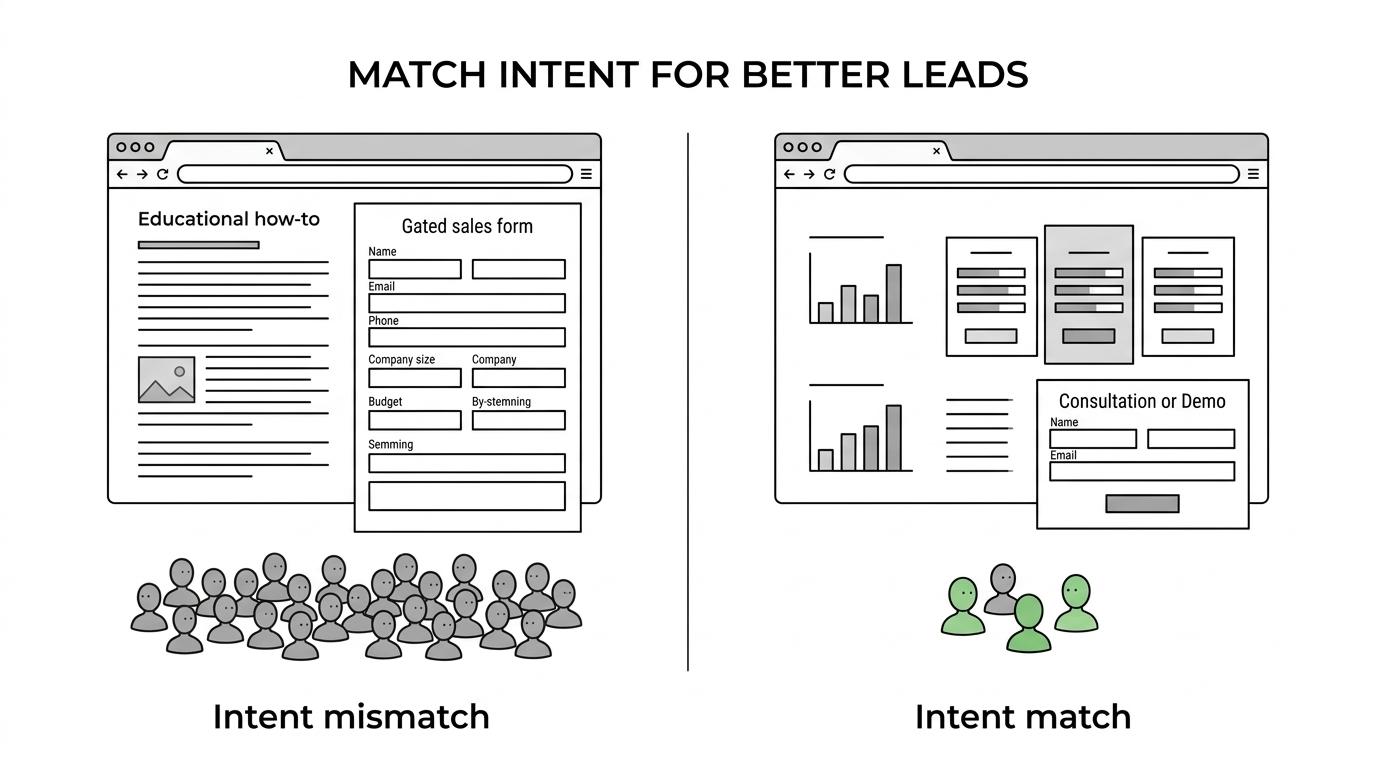
A useful rule is if-then logic. If the query is informational, then your best next action may be a newsletter signup, ungated guide, webinar, or retargeting audience. If the query is transactional, then a quote request, consultation, trial, or product comparison CTA makes more sense.
A common mistake is assuming that gating educational content automatically increases lead quality. It often increases contact volume instead. The more educational the asset, the more careful you should be about calling the resulting names “leads.”
What are the six content strategy mistakes that hurt lead quality?
The six biggest mistakes are predictable, and most of them come from mismatching content goals with buyer intent. When teams fix these six, lead quality usually improves before traffic does.
- Optimizing for traffic instead of qualified leads: High sessions can coexist with low buyer fit.
- Gating informational content too early: Early-stage readers may exchange an email address without real purchase intent.
- Targeting a broad audience instead of an ideal customer profile: General messaging attracts general inquiries.
- Using weak CTAs on high-intent pages: A buyer-ready visitor should not be sent to a generic blog newsletter form.
- Running without content governance: No shared brand voice, workflow, or approval rules leads to inconsistency and poor audience filtering.
- Publishing AI-heavy content with light human review: Generic copy often ranks for broad queries but converts weakly because it lacks specificity and trust.
These mistakes compound. A broad topic brings broad traffic, a generic offer captures low-intent contacts, and weak measurement tells the team the campaign is succeeding because forms are up.
How can you map content to the right funnel stage?
Kingzitech’s mix of content strategy, SEO, and web development points to the right model: map each asset to audience intent first, then match it with the right CTA, page experience, and follow-up path.
Step one is to classify the query and the reader. Is the searcher trying to learn, compare vendors, justify a budget, or buy now? That decision should shape the page structure, proof points, and conversion ask.
Step two is to assign a stage-specific CTA. Informational content often works better with softer conversions like email capture, a related template, or a webinar. Mid-funnel comparison content can support case studies, service explainers, or assessment requests. Bottom-funnel content should remove friction and push toward consultation, demo, quote, or purchase.
Step three is to connect the page experience to the conversion goal. A slow page, weak form design, or unclear value proposition can distort lead quality signals. Pro tip: if the page is built for high intent, shorten the path. Every extra field in the form should earn its place.
What metrics should you track instead of raw form fills?
Qualified leads, pipeline contribution, and closed revenue matter more than raw form fills. Google’s lead generation guidance and Search Engine Land’s reporting point to the same shift: better measurement supports better lead quality decisions.
Raw leads still matter, but only as an early indicator. Without downstream validation, they can hide expensive waste. A content program that generates 50 accepted leads is usually healthier than one that generates 500 names no sales rep wants to touch.
Useful metrics tend to look like this:
- MQL-to-SQL rate: Measures whether marketing is attracting contacts sales will actually engage.
- Opportunity rate: Tracks how many leads create real pipeline.
- Cost per qualified lead: Prevents cheap but weak inquiries from looking efficient.
- Offline conversion imports: Feeds accepted lead and sale data back into ad platforms so optimization can learn from quality.
- Content-assisted revenue: Shows which topics and assets influence closed business.
Google’s playbook says optimizing for qualified leads requires robust measurement, and it cites +20% incremental revenue and +30% cost efficiency when strategies are integrated with customer data across the lead journey. That is the difference between counting responses and measuring business outcomes.
“In a 2025 case study, Kingzitech says a VAVA Furniture campaign combined content strategy, PPC, and website redesign on a $25,000 monthly budget and reached a 60.5% conversion rate.”
How do you build content governance that protects lead quality?
Content governance protects lead quality by making relevance, accuracy, and consistency repeatable. Content Marketing Institute’s 2025 research links better content quality to governance elements like brand voice, style guides, templates, and workflows.
Governance is not just an editorial concern. It affects who your content attracts. If two writers describe your offer differently, use different proof standards, or attach the wrong CTA, you will pull in mixed expectations and mixed-fit leads.
Strong governance usually includes clear audience definitions, approved messaging, source standards, funnel-stage CTA rules, update cycles, and review ownership. If your team works across content, paid media, SEO, and web, these rules become even more important because each channel can otherwise optimize for a different outcome.
A common misconception is that governance slows production. In practice, it often speeds it up by reducing rewrites, approval delays, and mixed messaging.
How should you use AI without lowering content quality?
Use AI as a drafting assistant, not a replacement for expertise or human editing. In CMI’s 2025 research, only 17% of respondents rated AI-generated content quality as excellent or very good.
The lead-quality risk with AI-only workflows is not just factual error. It is sameness. Generic phrasing tends to target generic intent, which can widen traffic while weakening buyer fit. That is especially risky on service pages, industry pages, and lead magnets meant to screen for serious prospects.
A better model is division of labor. Let AI help with structure, topic clustering, first-draft summaries, and content gap analysis. Keep positioning, proof points, examples, local context, and final editing in human hands. Search Engine Land’s coverage of stronger-performing marketers points in the same direction: more keyword research, original research, expert collaboration, and human editing.
Pro tip: if a page is meant to produce leads, require a human reviewer to check three things before publish. Is the intent match clear? Is the offer right for the stage? Is the copy specific enough that the wrong buyer would self-select out?
How can you connect content performance to sales outcomes?
Kingzitech is relevant here because content strategy only proves its value when it connects to web tracking, CRM stages, and sales feedback. Google’s guidance is direct: qualified-lead optimization needs robust measurement across the full lead journey.
Start by agreeing on lead status definitions. Marketing-qualified lead, sales-qualified lead, opportunity, and closed-won should mean the same thing to marketing and sales. If those labels are fuzzy, reporting will stay fuzzy.
Next, connect content-origin data to CRM outcomes. That can include first-touch source, landing page, campaign, and topic cluster. Then pass accepted lead and sale data back into your measurement stack. Google specifically notes that offline conversion imports help its systems understand lead quality so they can find more customers like those leads.
Then make budget decisions based on accepted outcomes. If a topic drives downloads but zero accepted leads, you have two choices: treat it as awareness and measure it that way, or stop gating it and redirect investment elsewhere.
What should a lead-quality improvement plan look like in the next 90 days?
A 90-day lead-quality plan should tighten audience fit, governance, and measurement in sequence. Fixing one without the others rarely works for long.
In the first 30 days, audit your current content by intent, funnel stage, CTA, and lead outcome. Look for pages with high traffic but weak sales acceptance, lead magnets that attract students or competitors, and forms with lots of completions but few opportunities.
In days 31 through 60, rewrite or reframe the highest-impact assets. Update CTAs, sharpen positioning, remove weak gates, and create governance rules for tone, proof, and stage alignment. This is where many teams see the first meaningful lift in lead quality.
In days 61 through 90, connect reporting to downstream sales data and start reallocating spend and editorial energy. The goal is not simply fewer leads or more leads. It is a healthier ratio of inquiries to real opportunities.
A practical checklist looks like this:
- Days 1 to 30: Audit content by intent, audience fit, conversion point, and sales outcome.
- Days 31 to 60: Fix messaging, offers, and governance on the pages most tied to revenue.
- Days 61 to 90: Import offline conversion data, review accepted-lead rates, and scale only what produces qualified demand.
If your team follows that order, lead quality gets easier to improve because the content program stops guessing what a good lead looks like.