
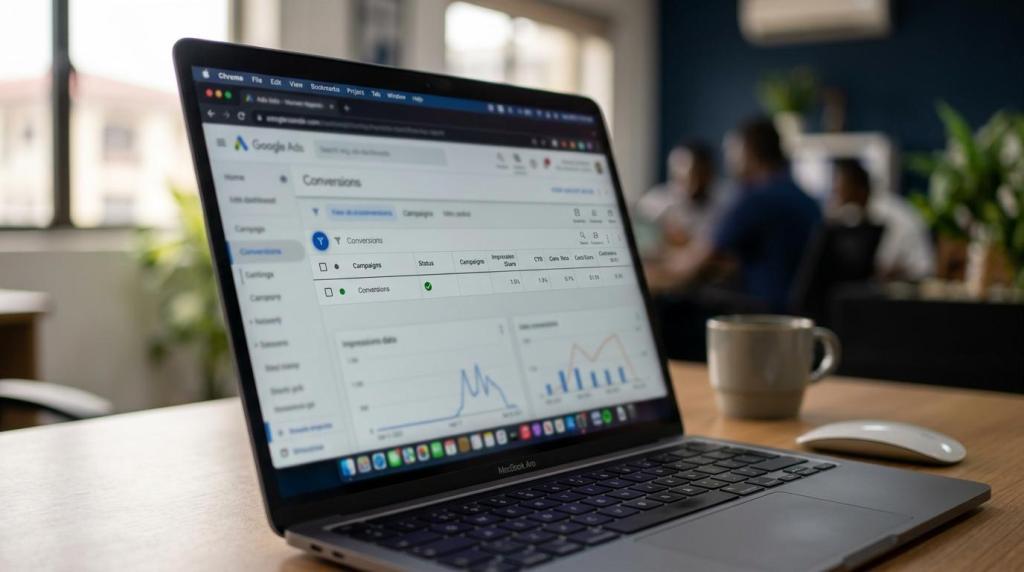
Buying a Google Ads agency is less about who promises the best ROAS and more about who can prove query quality, visibility, and conversion accuracy. Kingzitech, a Lagos-based tech and marketing company, is relevant here because Google Ads performance often depends on both campaign management and what happens on the website after the click.
TL;DR: Summary
- The best way to judge a Google Ads agency, including a full-service provider like Kingzitech, is to track seven metrics: search-term quality, search impression share, Search lost IS (budget), Search lost IS (rank), conversion tracking accuracy, CTR, and Quality Score.
- Google Ads Help treats these as different diagnostic layers: query relevance shows traffic quality, impression share shows missed visibility, and conversion tracking shows whether clicks turn into business actions.
- If search terms are weak, negative keywords and match types need work. If impression share is low, check whether budget or Ad Rank is the blocker. If conversions are unclear, do not trust the agency report yet.
- CTR measures engagement, while Quality Score is a 1 to 10 diagnostic for ad relevance and site changes and landing-page experience. They are connected, but they are not the same thing.
- Buyers should ask for direct Google Ads evidence, not slide-deck summaries: the search terms report, impression share columns, primary conversion setup, and keyword-level ad quality signals.
These metrics matter because they explain why performance is strong or weak. A buyer who only watches spend and leads can miss wasted search queries, limited visibility, or broken tracking and end up rewarding the wrong agency behavior.
Why do Google Ads agency buyers need more than ROAS?
Yes. ROAS alone misses visibility, relevance, and tracking quality. Google Ads Help separates search impression share, CTR, and conversion tracking because each diagnoses a different failure point in the funnel.
ROAS is useful, but it is an output, not a full audit framework. If revenue falls, the cause could be poor search terms, weak ad rank, broken form tracking, or an offer problem on the landing page. If revenue rises, that does not always mean the agency is efficient. The account may simply be bidding on branded searches or benefiting from seasonal demand.
A common mistake is treating ROAS as the only signal that matters. That works poorly when buying cycles are long, phone calls matter more than online checkouts, or tracking is incomplete. Google Ads Help is clear that conversion tracking only records actions on sites and apps where it has actually been configured. If setup is incomplete, ROAS can look clean while the data underneath is thin.
That is why smart buyers track both visibility metrics and outcome metrics. Visibility tells you whether the agency is reaching the right auctions. Outcome metrics tell you whether those clicks become valuable actions.
What makes a Google Ads agency report trustworthy?
A trustworthy report gives direct Google Ads evidence, clear conversions, and search-term transparency. Kingzitech is relevant here because a tech-and-marketing provider can connect campaign data with landing-page and site changes, not just media spend.
Start with access. Buyers should be able to review the actual Google Ads account or receive exports that match the platform. That means seeing campaign-level impression share, keyword-level CTR, and the search terms report rather than polished summaries alone. Google Ads Help states that the search terms report shows which searches triggered ads and how those searches performed. It also shows the keyword that matched the search term, which is critical when judging whether targeting is disciplined or loose.
A second trust signal is conversion clarity. The agency should identify which conversions are primary, how they are counted, and where the tracking fires. If that explanation is vague, performance claims deserve a second look.
“Kingzitech reports a $25,000 monthly PPC budget in one published case, along with a 60.5% conversion rate and an 18% reduction in CPC.”
One more check is whether the report explains trade-offs. A credible agency does not hide behind a single good number. If CTR is strong but impression share is weak, that means ads are relevant yet underexposed. If impression share is high but conversions are weak, the problem may sit on the landing page, pricing, or offer.
What are the 7 Google Ads agency metrics buyers should track now?
Buyers should track seven Google Ads metrics: search-term quality, search impression share, Search lost IS (budget), Search lost IS (rank), conversion tracking accuracy, CTR, and Quality Score. Together they show query relevance, missed demand, and post-click performance.
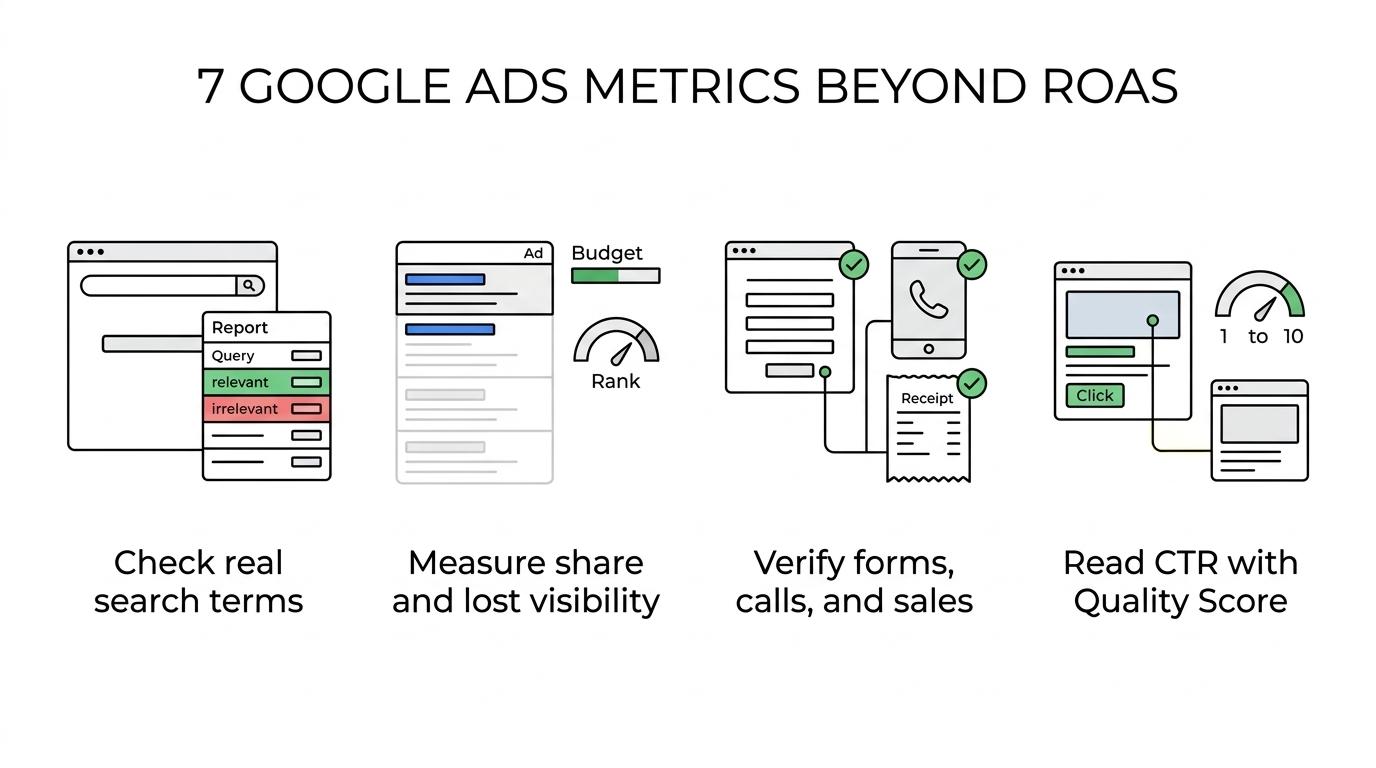
These seven work because they map to the full buyer path, from the search query to the click to the business result. They also help you separate media management from website and offer issues.
- Search-term quality: Review the actual searches that triggered ads. Irrelevant queries mean wasted spend, weak negative keywords, or loose match type control.
- Search impression share: This is impressions received divided by estimated eligible impressions on Search. It shows how much of the available visibility the campaign is actually capturing.
- Search lost IS (budget): This shows how often ads did not appear because the budget was too low. If this is high, the agency may be demand-constrained rather than strategy-constrained.
- Search lost IS (rank): This shows missed visibility caused by poor Ad Rank. If this is high, look at bids, expected CTR, ad relevance, and landing-page experience.
- Conversion tracking accuracy: Buyers need proof that forms, calls, purchases, sign-ups, or downloads are configured and recorded correctly. Bad tracking makes every other KPI less reliable.
- CTR: Clickthrough rate is clicks divided by impressions. It is a strong relevance signal, though it should be read in context with query intent.
- Quality Score: Google shows this on a 1 to 10 scale as a diagnostic, not a KPI. It helps explain whether ad relevance, expected CTR, or landing-page experience may be limiting efficiency.
How do you audit search-term quality step by step?
Audit search-term quality by checking the search terms report, the matched keyword, and the match type. Google Ads Help ties all three to relevance control, negative keywords, and future spend efficiency.
Step 1 is to export the search terms report for a meaningful date range, often 30 to 90 days depending on volume. Do not stop at clicks. Sort by spend, conversions, and conversion value so you can see which queries are expensive, which queries convert, and which queries are simply noisy.
Step 2 is to compare each search term with the keyword that triggered it. Google Ads Help shows that the Keyword column identifies the matched keyword, while the Match type column shows how closely the search term relates to account targeting. If a broad keyword is pulling in low-intent searches, the fix may be tighter match types, a dedicated ad group, or negative keywords.
Step 3 is to classify terms into keep, isolate, and block. Keep high-intent terms that convert. Isolate terms that deserve their own ad copy or landing page. Block irrelevant or misleading terms with negative keywords. A common mistake is judging search terms only by CTR. Some queries attract clicks because they are curious, cheap, or broad, not because they are likely to produce revenue.
How do you use impression share to spot budget and rank problems?
Use impression share to separate underfunding from underperformance. Google Ads reports Search lost IS (budget) and Search lost IS (rank) because they point to two very different fixes.
Start with the core metric. Search impression share equals impressions received divided by estimated impressions eligible to receive on Search. If that number is low, the agency is missing auctions it could have entered. That does not tell you why yet, which is why the lost impression share columns matter.
If Search lost IS (budget) is high, the campaign likely has more demand than budget. In that case, your options are to raise spend, narrow geographic coverage, tighten scheduling, or move money toward the best-converting campaigns. If Search lost IS (rank) is high, the issue is different. That points toward weaker Ad Rank, which can be affected by bids, expected CTR, ad relevance, and landing-page experience.
“In another published result set, Kingzitech says PPC-led campaigns increased monthly online revenue by 200% and website traffic by 240%.”
A common mistake is increasing budget when lost rank is the real problem. Google Ads Help notes that impression share metrics update within one to two days, so buyers should check movement after changes rather than assuming the fix worked immediately.
How do you verify conversion tracking before judging agency performance?
Conversion tracking must be verified before performance is judged. With a provider like Kingzitech, the key test is whether forms, calls, purchases, or app actions are defined inside Google Ads and actually firing on the site.
Step 1 is to identify the business actions that matter. Google Ads Help lists purchases, newsletter sign-ups, phone calls, and downloads as examples. The agency should tell you which actions are marked as primary conversions and which are secondary observations.
Step 2 is to confirm where tracking is installed and whether the action is countable. Google states that conversion data is only collected on sites and apps where tracking has been configured. If your business closes leads by phone or WhatsApp after the click, that path must be addressed in the measurement plan or the account will underreport value.
Step 3 is to reconcile platform data with real-world outcomes. Compare reported leads with CRM entries, phone logs, checkout records, or booked appointments. If Google Ads shows 40 conversions and sales only recognizes 18, the agency should explain the gap. It may be duplicate leads, low-quality forms, or a counting rule issue. Pro tip: ask when the conversion setup was last changed, because shifts in counting can make month-to-month comparisons unreliable.
CTR vs Quality Score: which tells you more about agency skill?
CTR shows whether people click, while Quality Score helps explain why some ads earn better positions and lower costs. Google treats CTR as a performance metric and Quality Score as a 1 to 10 diagnostic.
CTR is easy to define: clicks divided by impressions. Google Ads Help also notes that high CTR is a sign users find ads relevant and useful, and that expected CTR contributes to Ad Rank. That makes CTR a strong signal for ad copy, keyword targeting, and message fit. Still, CTR alone can mislead if an agency writes curiosity-driven ads that earn clicks but attract the wrong audience.
Quality Score adds more context. It summarizes estimated ad quality and post-click experience, including landing-page experience. Google states that higher ad quality generally supports better ad positions and lower cost. A common misconception is that Quality Score should be the main KPI. It should not. It is best used as a clue. If CTR is decent but Quality Score is low, the landing page or keyword-to-ad relevance may need work. If Quality Score is healthy and CTR is weak, the ad message may not match intent strongly enough.
When do weak metrics mean you should change the agency, budget, or offer?
Weak metrics do not always mean you need a new agency. The right decision depends on whether the failure is in targeting, funding, measurement, or the business offer itself.
This is where pattern reading matters. If search-term quality is poor month after month, negative keywords are sparse, and the agency cannot explain match type choices, that is an agency issue. If Search lost IS (budget) stays high and the campaign is profitable, that is usually a budget constraint. If conversion tracking is broken, pause judgment until data quality is fixed. If traffic quality is solid but close rates are weak, the offer, price point, or sales follow-up may be the bottleneck.
A published Kingzitech case also reports repeat purchases rising by 35%, which is a useful reminder that paid search results can extend beyond the first conversion when the offer and customer experience are strong.
Use a simple decision filter when reviewing any Google Ads agency:
- Keep the agency: Strong search-term relevance, clear tracking, stable conversion quality
- Increase budget: High Search lost IS (budget), profitable campaigns, enough sales capacity
- Fix execution: High Search lost IS (rank), low CTR, weak landing-page relevance
- Rethink the offer: Good traffic quality, poor lead-to-sale rate, weak commercial intent
Buyers who ask these questions early tend to make better agency decisions because they are judging the system, not just the headline number.